Documentation M3b record
M3b — compatible adoption proof#
Historical milestone record. M3b was met on 2026-08-11 against the Linux-x64-only scope of that date; that scope is superseded — Blitsen now publishes six desktop runtimes (Platform support). The Phase 1 "not yet cleared for redistribution" standing below is also superseded: releases 0.1.0–0.2.1 have since shipped with the notice flow that gate required. The gates (
test:m3b,test:third-party) still run against the current runtime.
M3b is met. The export pipeline works and is gated. The adoption claim it was declared on —
take a real, existing Vite application that we did not write and run it unchanged — was measured
against six applications on 2026-08-11 and all six failed. After the work that measurement
prompted, all six build and render from their own unmodified vite build output, with nothing
added but a dev dependency and a script line.
| Gate | What it proves | Result |
|---|---|---|
test:m3b | the export pipeline, on an application written here | passes |
test:third-party | adoption, on applications written by other people | 6/6 build and render unaided |
| Application | Builds | Renders |
|---|---|---|
| Shadcn Admin (React, Tailwind 4, Radix, TanStack, Recharts) | yes | 364 elements, 16 colours |
| vue3-realworld (Vue 3, vue-router, Pinia) | yes | 29 elements, 16 colours |
| Wordle+ (Svelte) | yes | 349 elements, 16 colours |
create-vite react-ts / vue-ts / svelte-ts | yes | 50 elements, 16 colours each |
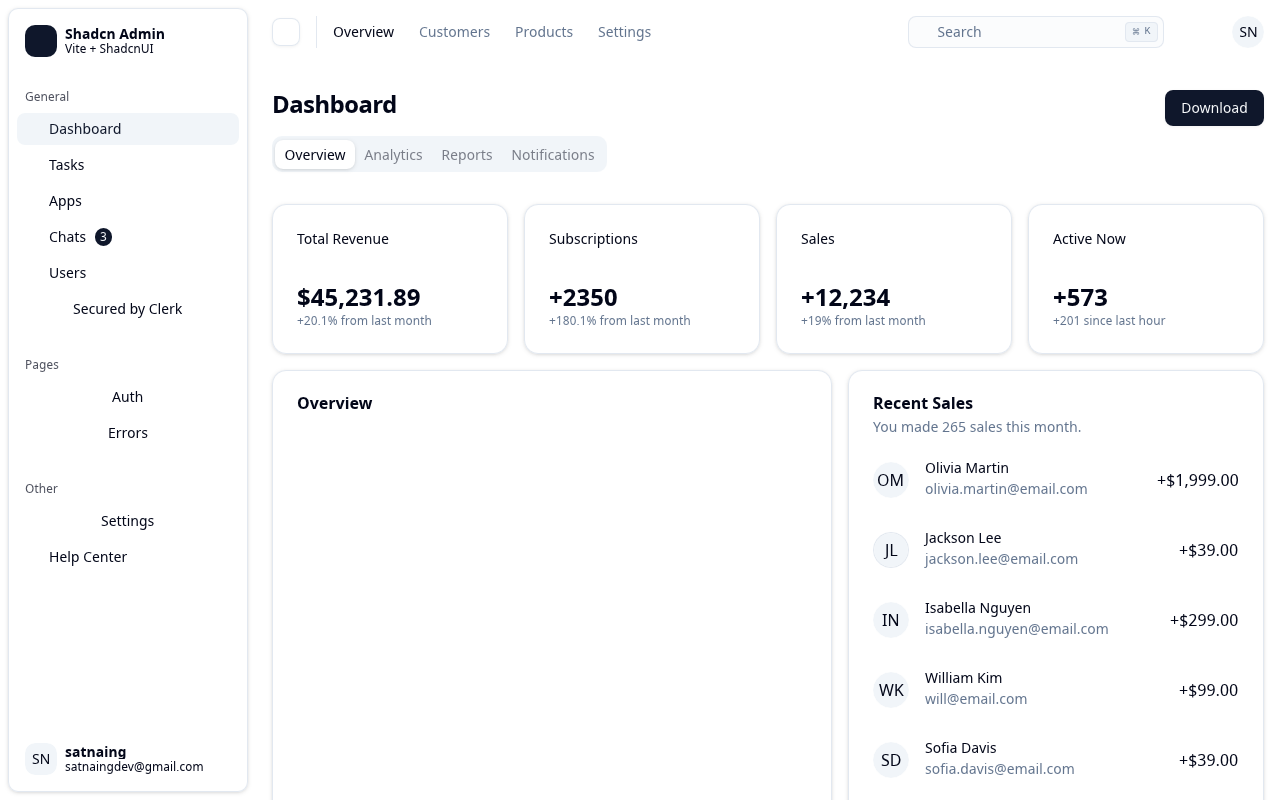
Zero source changes to any fixture, and no flags. P10 asks for one dev dependency and one script line, and that is what each of the six needed.
Wordle+ was the last to arrive, and what moved it was a severity rather than a capability. It loads
a Google Analytics tag; ASSET_REMOTE_SCRIPT was graded an error because a remote <script src>
used to abort the entire script run, so one analytics tag stopped every other script on the page.
That is fixed — the loader now skips the one script it will not fetch, says so on stderr, and runs
the rest of the document — which left the rule blocking builds for a reason that no longer existed.
It is a warning now. The position that an exported application should not silently phone home is
unchanged and is enforced where it actually holds: the runtime never fetches the script.
Deviations, recorded#
The gate is "renders correctly", not "renders identically", and these are the differences worth naming:
- Shadcn Admin's Recharts panel is empty. SVG rendering is limited, tracked upstream as blitz#448.
- Wordle+'s HOW TO PLAY overlay sits against the left edge rather than centred — the auto-margin defect this project filed as blitz#691.
- Wordle+ runs without its analytics tag, which is the intended behaviour rather than a defect.
- vue3-realworld's two stylesheets are remote CDN links and are answered with empty bytes, so it renders unstyled. That is a property of the fixture, not of the runtime.
What the six failures were#
Worth recording, because none of them was the export pipeline and one of them was a single line.
- A subresource we refused blocked painting for the life of the document. Blitz holds a stylesheet as a pending critical resource until its handler completes, and the trait's only failure signal is dropping that handler — which never completes it. Shadcn Admin mounted 364 elements with correct layout and correct computed styles, and painted 1,024,000 pixels of pure white, because its
<head>links a Google Fonts stylesheet.LocalResourcesnow answers every request, with empty bytes for anything it will not serve. doctorrefused builds over things that render. Decorativefilterandtransformwere graded errors on the strength of a capture whose real cause was elsewhere; so were references to absent APIs that real bundles feature-detect. Both are warnings now, and the stockcreate-vitetemplate went from refused to exported.- Missing DOM surface, found by probing the live bridge rather than one crash at a time:
createElementNS,createComment,link.relList, element traversal,getElementsByClassName, the*AttributeNStrio,getComputedStyle,matchMedia,ResizeObserver, theImageconstructor,navigator, and in-memorylocalStorage. - Assets a bundler resolved into string literals were dropped from the export as unreachable, so the stock template shipped without any of its images.
What test:m3b proves, and what it does not#
The acceptance application is examples/vite-react: a conventional
Vite 8 + React 19 application with no Blitsen imports, source branches, or Vite base-path override.
Its ordinary vite build emits dist/index.html with Vite's default root-relative asset URLs.
Blitsen scans that untouched output, normalizes local root-relative HTML/CSS references only in
the staged export, and embeds the three output files with the runtime into one executable.
blitsen doctor distreports zero compatibility errors and eight portability warnings, all in feature-detected paths inside React's own bundle:MessageChannelin the scheduler,FormDatafile bodies, two device APIs, and a media constructor. None of them is taken at runtime.- The production React module mounts after the host event loop advances. Vite's bootstrap uses a functional
MutationObserver; React sees stable DOM wrappers plus standard node identity fields. - The standalone gate runs the exported executable with an empty
PATH, asserts the React tree mounted, dispatches a bubbling click through React's delegated listener, and observes the state render change from0to1. - The optimized Linux x64 acceptance artifact measured 132,364,416 bytes installed. This is a Phase 1 Bun-hosted measurement, not a production size target.
- The gate exposed and fixed a compiled-host-only identity failure in the original cache. Wrapper identity is now weak on both sides of the bridge, with tokened finalization preventing a stale finalizer from removing a newer wrapper; application references preserve React's listener and fiber properties without retaining every detached node until document replacement.
The weakness is the application. examples/vite-react was written here, and its markup carries
data-react-ready="true", id="count" and id="increment" — the exact selectors
test/run-m3b.mjs queries. Its CSS was written against what the renderer already does, it ships
one chunk with no <link rel="modulepreload">, no remote asset, no localStorage, no SVG, and no
router. The gate therefore measures the export pipeline and the DOM bridge against markup shaped
for them. It is not evidence of adoption, and the milestone should never have been closed on it.
Third-party result (2026-08-11, Linux x64)#
Every application below was cloned at a pinned revision and built with its own unmodified build
command. No source change, config change, polyfill, or shim was applied to any of them. No
application-specific selector was added anywhere either: the render check counts elements below
<body> and distinct painted colours, so it works on applications whose markup we have never seen.
| Application | Framework | doctor | blitsen build | Rendered |
|---|---|---|---|---|
Shadcn Admin 70cfd30 | React 19, Tailwind 4, Radix, TanStack, Recharts | 78 errors, 43 warnings | refused | no — blank |
Vue 3 RealWorld a3b0731 | Vue 3, vue-router, Pinia | 15 errors, 8 warnings | refused | no — document did not load |
Wordle+ 199122b | Svelte 3 | 55 errors, 2 warnings | refused | no — document did not load |
create-vite@9.1.2 --template react-ts | React 19 | 3 errors, 8 warnings | refused | no — blank |
create-vite@9.1.2 --template vue-ts | Vue 3 | 3 errors, 0 warnings | refused | no — document did not load |
create-vite@9.1.2 --template svelte-ts | Svelte 5 | 3 errors, 1 warning | refused | no — document did not load |
The last three are the floor of the claim: the official Vite starter templates, unedited. All three
are refused by doctor for the same three declarations in the template's decorative CSS — one
filter: invert() inside a media query and two transform: perspective(…) rules on the hero
artwork — so blitsen build never reaches the exporter. None of the three renders either.
What the frames show#
doctor blocks build, so the render evidence stages each dist exactly as the exporter would
(the same planIngest and root-relative rewrite) and loads it directly. That is the most generous
possible reading: the gate is bypassed and the runtime still produces nothing.
- Shadcn Admin — one PNG, 1280×800, 1,024,000 pixels of
#ffffff. Not a partial dashboard: a white page. The post-JavaScript DOM has 30 nodes, all of them the shipped shell (<head>, the stylesheet,<body>, an empty<div id="root">). React itself loaded and ran. create-vite react-ts— white except for two 1-pixel vertical grey (#e5e4e7) hairlines at x≈77 and x≈1202, running the full height: the edges of the template's empty centred#rootcontainer. 1,600 non-white pixels out of 1,024,000.#rootis empty.- Vue 3 RealWorld, Wordle+,
vue-ts,svelte-ts— no frame at all. The document load throws before the first layout, so there is nothing to paint.
For contrast, the same pipeline at the same 1280×800 viewport on examples/vite-react mounts 17
elements below <body> and paints 16 colours: heading, card, three stat tiles, and the Increment
button, all legible. That is the threshold the check uses — 10 elements and 3 colours.
Where each one stops#
| Application | First blocker | Cause |
|---|---|---|
| Shadcn Admin | ReferenceError: localStorage is not defined during React's first render | the theme provider does useState(() => localStorage.getItem("vite-ui-theme") ?? …), so the whole tree throws; the effect right behind it calls window.matchMedia, which is also absent |
create-vite react-ts | document.createElementNS is not a function | React's DOM renderer creates SVG elements through createElementNS; the template's logos are inline SVG |
| Vue 3 RealWorld | document.createComment is not a function | Vue's runtime creates a comment anchor for every fragment, so no Vue application can mount |
create-vite vue-ts | document.createElementNS is not a function | same as React: the template's inline SVG logos |
| Wordle+ | script src must be relative to the entrypoint: https://www.googletagmanager.com/… | the loader refuses any remote <script src>; here it is an async analytics tag whose own inline follow-up is origin-guarded and would have done nothing |
create-vite svelte-ts | navigator is not defined | Svelte 5.56's client runtime reads navigator.userAgent unguarded while initializing |
A second, independent blocker sits in front of every code-split Vite build: link.relList is
absent, so Vite's own module-preload polyfill decides the host cannot preload and calls
fetch(link.href) on each <link rel="modulepreload">. The document base is blitsen://app/, and
fetch rejects it with fetch supports http and https; blitsen: has no server behind it. The
in-repo example never trips this, because a single-chunk build emits no preload links at all.
Vue 3 RealWorld emits five and takes the path on every load.
The absent surface behind those failures#
Probed directly through the bridge harness, in the same runtime the export uses:
| Area | Present | Absent |
|---|---|---|
| Node creation | createElement, createTextNode, innerHTML | createComment, createDocumentFragment, createElementNS, insertAdjacentHTML, template.content, DOMParser, Range |
| Traversal | document.querySelector, childNodes, classList, style.setProperty | element.querySelector, element.children, firstElementChild, closest, dataset |
| Host | MutationObserver, history, crypto.randomUUID, fetch (absolute http(s) only) | localStorage, sessionStorage, navigator, matchMedia, getComputedStyle, ResizeObserver, IntersectionObserver, requestIdleCallback, Element.animate, attachShadow, elementFromPoint, XMLHttpRequest, canvas.getContext |
link.relList is absent, location.href is blitsen://app/, document.baseURI is undefined, and
fetch accepts only absolute http(s) URLs, so an application cannot fetch its own bundled files.
Feature detection does not rescue these. Vue and React do not test for createComment or
createElementNS; Svelte 5 does not test for navigator; Shadcn Admin does not test for
localStorage. They are unconditional in every framework's mount path.
Deviations required#
None were made, which is the point: this run records what adoption costs, not a manufactured pass.
Getting any of these six to render would need source edits to third-party applications, so P10 is
not met. The nearest fixture, Shadcn Admin, would need at least a localStorage shim, an SVG
namespace shim, and its remote font links removed before it could be judged on layout at all — and
that is only the list of blockers reached so far. Each fix exposes the next one behind it.
Two failures are also worth separating from the runtime gaps, because they are ours to soften:
doctoris a wall, not a report, and its errors are not all real. It is a regex scan over minified output, so a blocking error is not evidence the application does the thing. Shadcn Admin's twoWEB_CANVASerrors are TanStack Table'scolumn.getContext(); itsWEB_XHR,WEB_COMPONENTSandWEB_STORAGEerrors sit behindtypeof XMLHttpRequest < "u",typeof ShadowRoot < "u"and atry/catch— exactly the feature detection the guidance asks for. Vue 3 RealWorld is blocked partly byopacity: 1. There is no override flag, so an application cannot be exported and looked at until every one of these is gone. Whether inert or feature-detected code should block a build is a product decision, not a technical one. (A CSS diagnostic also reports one line early, because its pattern anchors on the previous declaration's;.)- Remote assets are treated inconsistently. A remote
<link rel="stylesheet">(Shadcn Admin's Google Fonts) is an ingest warning that still loads; a remote<script src>(Wordle+'s analytics tag) is a fatal load error. A browser tolerates both, and the second is what stops Wordle+ from being measured at all.
Both were softened, which is what took this from 0/6 to 6/6. doctor now grades feature-detected
references and decorative CSS as warnings, and a remote <script src> as a warning too, once the
loader stopped aborting the whole run over one. Neither softening changes what the runtime fetches:
the answer for every remote subresource is still nothing.
Repeating this#
bun run --cwd packages/blitsen test:m3b            # the export pipeline gate (CI)
bun run --cwd packages/blitsen test:third-party    # the adoption gate (opt-in, not CI)
test:third-party needs network, npm, npx and corepack. It clones three repositories at pinned
revisions, scaffolds three templates from a pinned create-vite, and runs their real builds, so it
takes several minutes on a cold cache. It is deliberately outside CI —
CI must not depend on cloning other people's repositories — and it currently exits non-zero,
because the claim it measures is currently false. --only <name> runs one fixture and
--work <dir> reuses checkouts between runs. Frames, render.json per fixture, and summary.json
land in target/third-party/.
This proves the M3b adoption and compatibility boundary, not general browser compatibility. The
published v0 profile and doctor diagnostics define that boundary; the gap
between that profile and what real Vite output does is what the table above measures. The renderer
side of the same question is tracked in BLITZ-GAPS.md, and the earlier
whole-application survey is spikes/s6. As with M3, the Phase 1
executable is an internal architecture proof and is not yet cleared for redistribution until the
licensing gate in LICENSING.md is automated.